our collection of reference books, magazines and places serves as our enduring cultural compass.
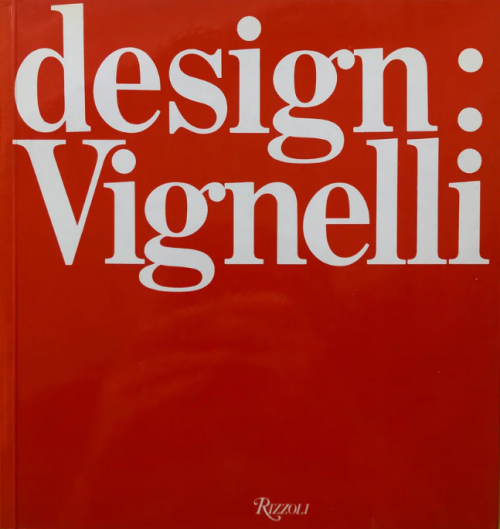
Design Vignelli
Design: Vignelli, Rizzoli International Publications, 1981
Massimo Vignelli
Book
‘The works illustrated in this book were originally selected for an exhibition at the Parsons School of Design, New York City, in 1980. The curator of the exhibition was Mildred Constantine, former curator of graphic design at the Museum of Modern Art in New York City. The exhibition was subsequently held at the Padiglione d’Arte Contemporanea m Milano, Italy, under the auspices of the Comune di Milano, in the same year. This book was originally published as the catalogue of that exhibition.’
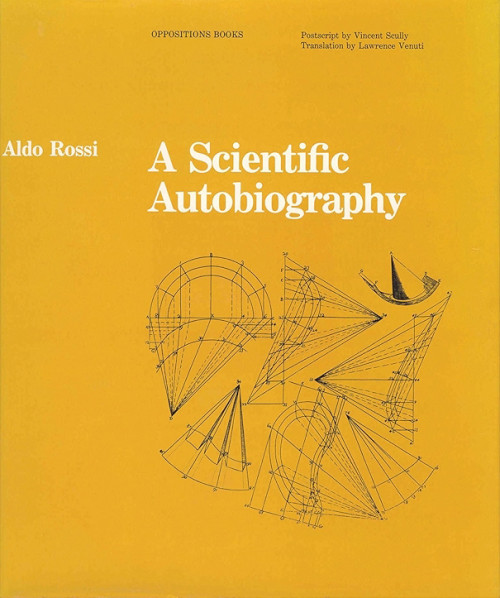
a scientific autobiography
A Scientific Autobiography, MIT Press, 1982
Aldo Rossi
This revealing memoir by Aldo Rossi (1937–1997), one of the most visible and controversial figures ever on the international architecture scene, intermingles discussions of Rossi’s architectural projects—including the major literary and artistic influences on his work—with his personal history. Drawn from notebooks Rossi kept beginning in 1971, these ruminations and reflections range from his obsession with theater to his concept of architecture as ritual. The book originally appeared as one of the landmark titles in the MIT Press’s Oppositions Books series, but has been out of print for many years. This newly issued paperback reprint includes illustrations—photographs, evocative images, and a set of drawings of Rossi’s major architectural projects prepared particularly for this publication—selected by the author himself to augment the text.
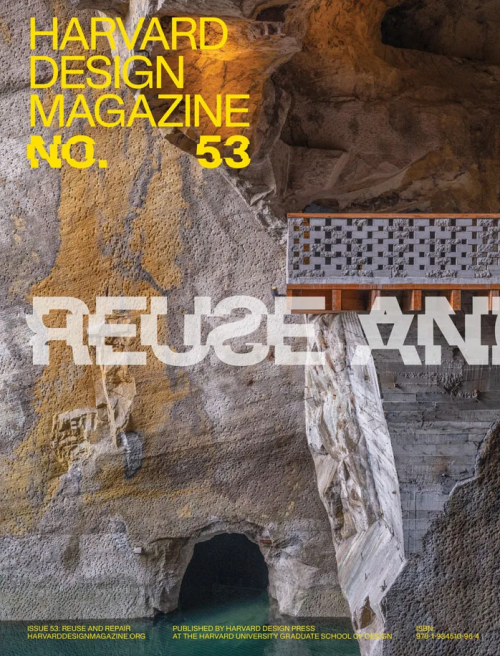
Reuse and Repair
Harvard Design Magazine 53: Reuse and Repair, HGSD, 2025
Put the city up; tear the city down,
put it up again; let us find a city.
Carl Sandburg, “The Windy City,” 1922
This issue of Harvard Design Magazine seeks to develop and expand this increasingly vital movement, engaging reuse across multiple scales—from individual buildings to downtown streets and the regulatory frameworks that organize our cities. Highlighting creative and interdisciplinary thinking, the issue promotes the act of bringing new life to what already exists as a powerful brief for designers, their clients, and the communities they serve. As resistance to viewing the reuse and repair of buildings as a legitimate form of design wanes, the appeal at the heart of Sandburg’s poem—“let us find a city”—is hopefully capturing the attention of future generations. This issue asks: If we free ourselves from the inherited limits on design practice, what new kinds of architecture, cities, and ways of being might we create?
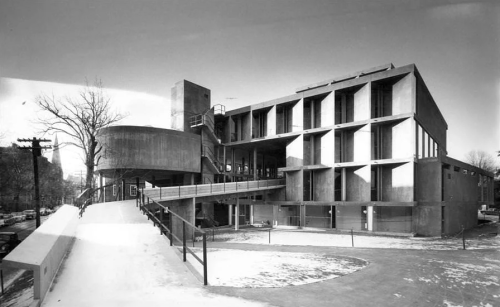
Carpenter Center Harvard
The Carpenter Center is the only building built by Le Corbusier in North America; it is also one of the last buildings he completed.
Since 1968, the Carpenter Center for the Visual Arts has housed the Department of Visual and Environmental Studies, renamed the Department of Art, Film, and Visual Studies in 2019. As such, it houses the Harvard Film Archive.
It is a part of American heritage; it has been listed in the National Register of Historic Places since 1978. Restored several times, it is still used by Harvard University.